

Grounding Financialization
A guest post by Chenab Navalkha
This week, we’re hearing from one of our favorite researchers, Chenab Navalkha, who has spent the last five years tracing how tenant organizers have responded to the financialization of housing at the national level. Her dissertation, Grounding Financialization: Property, Finance, and Tenant Politics in the United States, unpacks what she calls the “property-finance” nexus — the idea that housing today is increasingly governed through the interaction of property and finance. We have learned so much from Chenab as a colleague and scholar. Read on to learn from her too!
***
Housing financialization has become a major object of academic study, with scholars documenting how rental housing has become increasingly entangled with financial markets, the expansion of mortgage securitization, and the growing role of institutional investors and private equity in housing. At the same time, tenant organizers have been grappling with these transformations in real time. These projects often run in parallel: academics work to understand how financialized housing markets function, producing explanations, while organizers work to intervene in them, developing strategy.
Over the last five years, through my work with the Homes Guarantee and later the Tenant Union Federation, I became interested in what might emerge if we took these two projects seriously together. What might we learn about financialization if we started not from investors, regulators, or financial firms, but from the people trying to organize against them? How do tenants encounter these systems in everyday life? And what kinds of knowledge do they have to produce in order to act on them?
In my dissertation, I put these questions to the test by examining the last time tenant organizing scaled from local struggles to national politics, in the late 1960s and early 1970s. I asked: what did it look like to organize before housing finance became such a central feature of housing governance? I then look to a current example of national tenant organizing taking on financialization: the Tenant Union Federation’s campaign to condition federally-backed loans on tenant protections.
What emerged over the course of tracing this history was what I describe in the dissertation as the property-finance nexus: the idea that housing today is increasingly governed through the interaction of property and finance. In comparing tenant organizing of today with that of the 1960s and early 70s, my argument is not that finance replaced property. In our contemporary landscape, landlords, ownership, and property rights remain enormously important. Rather, property continues to organize relationships among tenants, landlords, and the state. And finance increasingly organizes the allocation of risk, profit, and investment. What has changed is that these domains have become more deeply intertwined.
The National Tenants Organization: Organizing before the “financial turn”
There are well-known accounts of tenant organizing in the 1970s and 1980s, particularly around rent control fights. But my work in the archives of Civil Rights organizations and the Poor People’s Campaign led me to a lesser known account of the National Tenants Organization (NTO).
NTO organizers were part of a burgeoning tenant movement grappling with how poor and working-class residents could exercise power over the conditions of their homes and communities. In cities like Chicago in the 1960s, a wave of tenant organizing emerged directly out of the Civil Rights Movement and struggle for Black freedom. One early tenant union emerged from the Chicago Freedom Movement, a campaign led by the Southern Christian Leadership Conference to bring the civil rights struggle to the north: the East Garfield Park Union to End Slums. Tenant unions, in this context, were not simply vehicles for demanding repairs but rather were envisioned as “democratic structures” through which residents—especially Black residents locked out of mainstream politics—might exercise collective power and participate in shaping their neighborhoods.
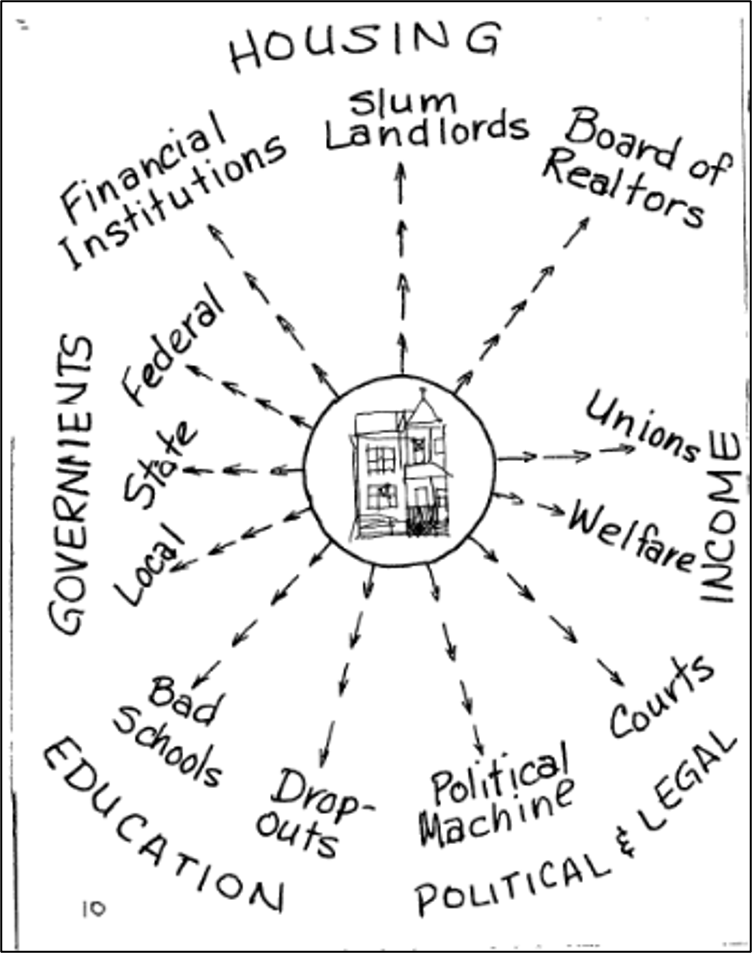
Across the country, the central struggle in tenant organizing was over the social relations of property. Organizers sought to establish obligations between landlords, tenants, and the state. Rent strikes, collectively bargained agreements, and legal reforms were all ways of challenging the near-absolute authority landlords exercised over housing. One of the movement’s legal victories, Javins v. First National Realty Corporation, emerged directly from a rent strike in Washington, D.C. The ruling established an implied warranty of habitability, recognizing for the first time that landlords had an obligation to maintain housing conditions rather than simply collect rent.
At the national level, the National Tenant Organization, which formed in 1969 to convene and disseminate information across tenant unions that had emerged across the country, pursued similar goals. Working with HUD, organizers helped shape a Model Lease for public housing and pushed for formal avenues through which tenants could participate in housing governance. The movement’s major victories centered on making relationships visible and accountable: defining rights, codifying obligations, and creating mechanisms through which residents could contest decisions affecting their homes.
By the early 1970s, the NTO had hundreds of local affiliates across the country and some observers speculated that tenant unions might become a political force comparable to organized labor—in the words of H. Clarke Wells, a developer who wrote a House + Home column tracking the emerging national tenant movement,
“Tenants are organizing. And as apartment projects get larger and developer/managers spread branch operations over multi-state regions, organized tenants will be following suit. Given strong, permanent leadership, apartment tenants could be organized on a national scale and controlled by a head-quarters staff as effectively as any national labor union ... a national tenants’ union is inevitable.”
In my research, I encountered arguments that housing activists had focused too narrowly on the visible actors they encountered in everyday life: landlords, speculators, and developers, to the detriment of an analysis of deeper institutional arrangements that structured the housing system, particularly the role of mortgage finance and capital markets. What I found in the archives suggests that tenant organizers in the 1960s possessed a far richer structural analysis than those critiques acknowledged. Organizers in East Garfield Park and elsewhere understood housing not simply as a question of shelter, but as part of a broader racialized political economy that extracted wealth and resources from Black neighborhoods while returning little in exchange. They did not understand slum housing as the result of a few bad landlords, but rather, as Dr. Martin Luther King Jr. described it, as part of an urban “slum economy” that profited from segregation and disinvestment.
But what those critiques picked up on, in hindsight, is that these struggles largely unfolded on terrain that was comparatively legible. Organizers confronted landlords, housing authorities, courts, and public agencies. The institutions shaping housing outcomes were often unequal and exclusionary, but they were also relatively visible. Because rental housing had not yet been swept up into practices of mortgage securitization and transactions on a secondary market, the strategies of the 60s and 70s focused on making landlords accountable, reforming public housing governance, winning legal recognition for tenant rights, and building democratic institutions through which residents could shape the conditions of their communities.
From Property to Finance
In the same years that tenant unions were negotiating collectively bargained leases and pushing for tenant participation in housing governance, federal policymakers were expanding mortgage securitization and building the foundations of the contemporary housing finance system. The terrain of housing governance was slowly shifting away from institutions rooted in place and toward institutions organized around the circulation of capital.
The shift from the world of the National Tenant Organization to our present moment did not happen all at once. It unfolded through a series of crises and political decisions that progressively deepened the links between housing and finance. Throughout the second half of the twentieth century, federal policymakers increasingly turned toward housing finance and credit as tools for addressing economic, social, and political problems. Rather than directly providing housing, the federal government expanded its role in creating, stabilizing, and governing markets for housing finance. Mortgage-backed securities, secondary mortgage markets, new lending programs, and eventually federal support for increasingly sophisticated financial instruments all emerged as ways of governing housing through markets rather than through direct provision.
The result was a gradual transformation in the institutions through which housing was governed. In the 1960s and early 1970s, tenant organizers largely confronted landlords, housing authorities, courts, and local governments. By the early twenty-first century, many of the forces shaping what happened in a rental building lay elsewhere: within loan agreements, mortgage-backed securities, underwriting standards, servicing arrangements, and federal housing finance institutions such as Fannie Mae and Freddie Mac.
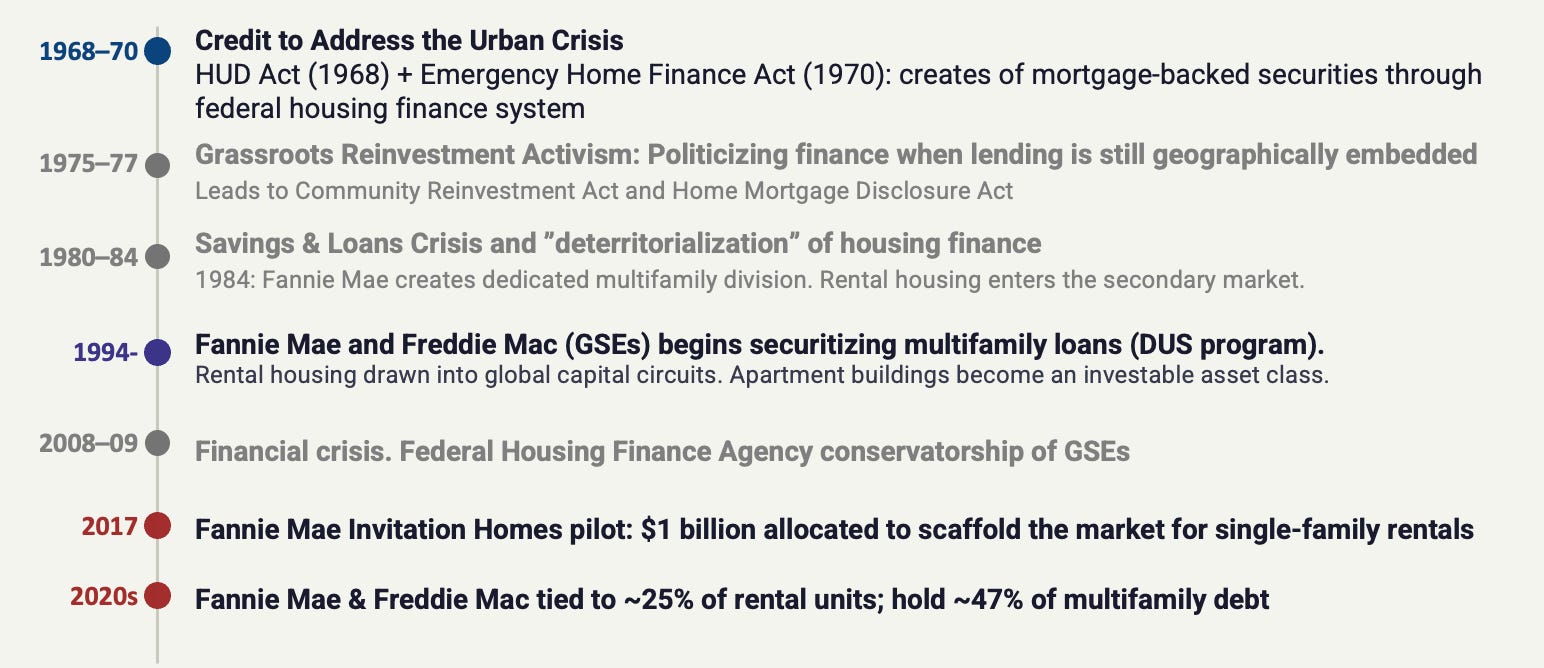
A key feature of financialization is abstraction: through financial instruments, housing is represented abstractly within market systems in order to translate it into a basis for investment. As housing is made into a financial asset, where rental properties serve as collateral for financial instruments and capital flows in secondary and tertiary markets, decisions affecting housing become increasingly distant from the places and people they affect. Sociologist Kevin Fox Gotham describes this process as a form of deterritorialization: housing finance becoming progressively detached from place and reoriented toward broader financial markets. What had once been relationships rooted in local lenders, local borrowers, and local communities increasingly became embedded within national and global circuits of capital.
Today, tenant organizers have to combat abstraction, clarifying the links between the processes that make rental housing into an asset and conditions on the ground, and linking the ways that rent flows through mortgages to the conditions of tenants’ homes and landlords’ behaviors.
The Tenant Union Federation: Grounding Housing Finance
In 2023, the Tenant Union Federation (then Homes Guarantee Campaign) targeted the Federal Housing Finance Agency in an attempt to get the federal government to realize national tenant protections. Organizers and researchers affiliated with the Tenant Union Federation’s research and policy team worked together to develop, test, and refine hypotheses about how the multifamily rental housing market works today in order to identify the leverage that tenants collectively have within our economic system. Wading into territory oft-overlooked by academic researchers, this group developed tools, research, political education, and organizing plans focused on the role that financial institutions play in shaping building conditions and rents on the ground.
In the process, Tenant Union Federation researchers found themselves trying to answer a deceptively simple question: who actually profits from a tenant’s rent check? In doing so, they learned how to trace ownership structures, read loan documents, navigate investor portals, and understand the mechanisms through which mortgage debt circulates through financial markets. The systems they were trying to understand were designed primarily for investors, lenders, regulators, and financial professionals. None of this knowledge was being produced for tenants. The challenge was not only accessing information, but also translating that information into something politically useful.
Answering that question required moving beyond the level of the landlord and into the broader infrastructure of housing finance. Follow a rent payment far enough and it becomes possible to see how rental housing is connected to mortgage servicing, securitization, and the federally backed financial instruments supported by Fannie Mae and Freddie Mac. What appeared at first as a local housing issue increasingly revealed itself as part of a much larger, national system. At first glance, FHFA might seem like a strange target for tenant organizing. Most people associate the agency with homeownership and mortgage markets, not rental housing. But organizers had begun to recognize that federal housing finance institutions had become key actors in rental housing, backing one in four properties. The conditions tenants experienced inside apartment buildings were often linked to financing arrangements taking place far upstream of the landlord-tenant relationship.
Through the campaign, FHFA officials often appeared sympathetic to tenants’ concerns. In one conversation, an agency staff member remarked to organizers that tenants were ultimately the ones paying the mortgages through their rent payments. The statement acknowledged something organizers had been trying to make visible for years: tenants were not external to the housing finance system, but rather a fundamental part of it, as their rents anchored revenue flows through mortgages.
At the same time, recognition did not necessarily translate into regulatory action. The limitations of the campaign illuminated a tension built into contemporary housing governance. Institutions such as FHFA operate under a dual mandate. They are expected to support affordable housing and broader public goals, but they are also tasked with maintaining the stability and liquidity of housing finance markets. These objectives do not always align, and are often at odds.
The FHFA campaign helped crystallize the importance of understanding financialization as not simply a market phenomenon. The dominant narrative about neoliberal housing policy often suggests that government stepped back and left housing to the market. But in reality, the state did not disappear. Rather, its capacity was redirected; the expansion of housing finance has been actively supported and governed by public institutions. As scholars such as Daniela Gabor have argued, contemporary states increasingly govern through financial markets rather than outside of them. For tenant organizers, this creates a distinctive political challenge. Demands such as rent regulation, anti-displacement protections, and stronger tenant rights increasingly appear not only as housing policy interventions but also as interventions into the functioning of financial markets themselves.
Abstraction does not eliminate politics
Looking across the National Tenant Organization of the 1960s and 1970s and the Tenant Union Federation today, what stands out is not that struggles over housing have disappeared, but that the terrain on which those struggles unfold has shifted.
The organizers I encountered in the archives were fighting to establish obligations between landlords, tenants, and the state. Their struggles centered on what I describe as the social relations of property: who had authority, who had rights, and what responsibilities came with property ownership. Tenant unions and organizers today continue to confront those questions. But they also face an additional challenge. Increasingly, the institutions shaping housing outcomes are embedded within systems of housing finance that operate at a considerable distance from the places they affect.
Housing today is governed not simply through property relations, nor simply through financial markets, but through their interaction. Property continues to structure relationships among tenants, landlords, and the state. Finance increasingly shapes the allocation of risk, investment, profit, and decision-making. The result is a system in which many of the forces governing housing become difficult to see, difficult to access, and difficult to contest.
Yet one of the most important lessons I take from this research is that abstraction does not eliminate politics. Over the course of this project, I watched tenant organizers develop new forms of expertise and new methods for making financial infrastructures legible. Property profiles, strategic research, political education, and campaigns targeting federal housing finance institutions are all efforts to answer a basic democratic question: how do ordinary people make claims on systems that increasingly operate through technical and financial forms of governance?
Organizers and movement researchers are not only responding to the consequences of financialization. They are producing knowledge about how financialized housing works—and crucially, how the federal government is involved in the deepening links between housing and global capital markets, and the deepening contradiction between housing as a fundamental need and financial asset. In doing so, they are forcing questions that are often treated as technical matters of market management back into the realm of political contestation.
For academics, there is something important to learn from this. Scholars have become increasingly sophisticated at describing financialization from above—through institutions, markets, investors, and state policy. But tenant organizers are often encountering these same systems from below and, in the process, generating forms of knowledge that reveal how those systems actually operate in everyday life.
For organizers, the history of earlier tenant movements is equally instructive. The National Tenant Organization reminds us that organizing has always involved making systems visible, identifying sites of accountability, and building institutions through which ordinary people can exercise collective power. What has changed is not the need for those activities, but the institutions toward which they are directed.
Grounding financialization, then, is an ongoing effort to connect the abstractions of housing finance back to the places, relationships, and communities through which people experience them—and to expand the possibilities for democratic action in the process.